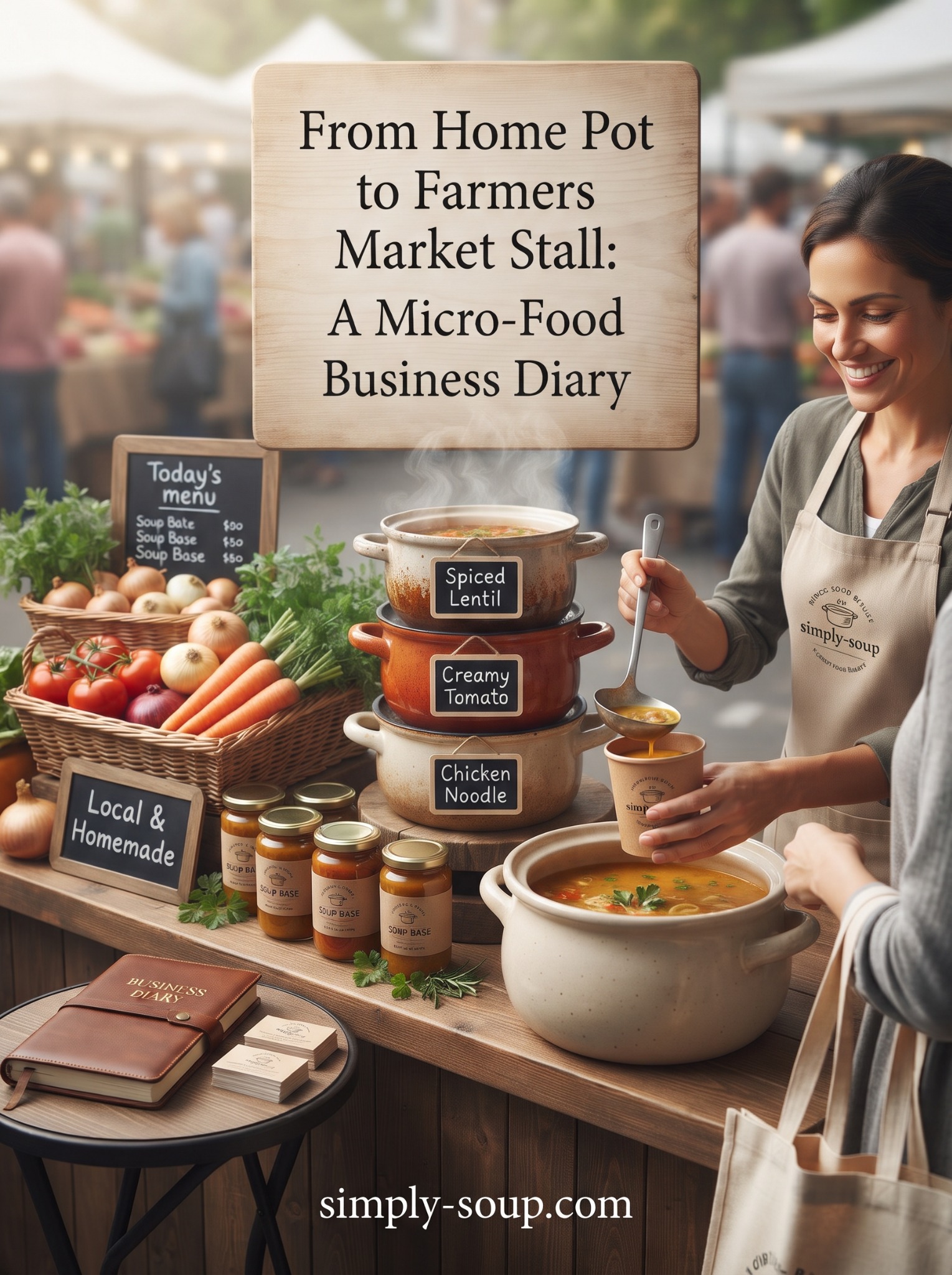
The idea often begins with a compliment: “You should sell this.” Perhaps it is a lentil soup that disappears at family lunches, or a tomato soup friends request whenever the weather turns. Turning that encouragement into a market stall takes a different set of skills: consistent portions, safe handling, sensible prices and the ability to serve someone while another customer asks about ingredients.
Our Pinterest image captures the appeal: seasonal vegetables, steaming soup and a friendly face behind the counter. This diary explores the work behind that scene, from the first notebook entry to the journey home after a first market.
Maya is a fictional beginner, and all sales, costs and timings below are worked examples rather than market averages or income promises. The practical route is aimed primarily at England; readers elsewhere should confirm local requirements. Allow enough time for registration, permissions and preparation before setting a launch date.
Entry 1: “I need a smaller idea”
Maya’s first notebook page contains six soups, three breads and a range of takeaway jars. Her second page contains a more useful question: what can one person produce safely, transport reliably and explain clearly?
She settles on two soups served hot in one cup size. Bread will wait until she understands demand. Chilled takeaway products will wait until she has a separate storage, labelling and shelf-life plan. Narrowing the offer reduces ingredient shopping, equipment requirements and decisions at the counter.
This is the appeal of a soup-focused business. A familiar format can carry different seasonal flavours, while customers understand what they are buying. However, a short menu does not automatically mean easy profits. Weather, footfall, waste and preparation time all affect the outcome. Our guide to the soup business model explores those trade-offs.
Try this: complete the sentence, “I serve ___ to ___ at ___.” Maya writes: “I serve two warming soups to lunchtime market shoppers at a local Saturday market.” This gives her something specific to test.
Entry 2: “The market visit comes before the equipment shopping”
Maya visits a market as a customer. She observes where people stop, whether they carry food while shopping, and whether nearby seating makes a hot lunch practical. She notes competing meals and their portion sizes, without assuming another trader’s queue guarantees demand for soup.
She asks the organiser about pitch fees, cancellation arrangements, electricity capacity, water, waste disposal, arrival times and permitted cooking equipment. She also checks whether the market has producer or local-sourcing criteria. A farmers market may have its own conditions beyond general food law.
Before paying, she asks what insurance and documentation the organiser requires and checks licensing with the council. Public and product liability cover are common practical considerations, but she checks the actual policy terms rather than assuming all market activities are covered.
The official registration guidance says food businesses in England, Wales and Northern Ireland must register with their local authority at least 28 days before trading. Home-based and temporary businesses are included. Maya contacts environmental health about her kitchen and mobile trading arrangements; registration itself is free. She does not treat registration as a certificate that every aspect of her setup has been approved.
She also checks permission to use her home, relevant insurance and any tenancy or mortgage restrictions. The FSA’s starting-a-food-business guidance is her first reference. A first market can be a modest pilot, but being small does not remove the need to prepare properly.
Entry 3: “A recipe needs to work twice”
Maya chooses a spiced lentil soup and a smooth tomato soup. The colours and names echo the welcoming stall in our image, while sharing some ingredients makes purchasing easier. She keeps the recipes distinct enough that customers have a real choice.
There is a useful culinary idea here: pulses can give soup body, while blending vegetables creates texture without automatically needing cream. Rather than attaching an invented regional origin to her recipes, Maya describes what is actually in each pot. Clear ingredient-led descriptions are more useful than an elaborate story she cannot substantiate.
For inspiration, see our country lentil and kale soup and roasted tomato and basil bisque. These are household starting points to test, not commercially validated production specifications.
She records ingredient weights, brands, cooking method and finished yield. A pot that begins with six litres of liquid will not necessarily produce six litres of finished soup. Evaporation, vegetables and thickness change the result.
Her chosen serving is 300 ml in a suitably larger, heat-safe cup with room below the rim. She measures the actual ladle portions instead of judging by eye. At that serving size, 12 litres of saleable soup gives 40 portions before samples or spillage. The calculation is 12,000 ÷ 300—not an estimate based on the pot’s advertised capacity.
She tests the soup after holding it using her intended service method. Does it thicken? Does the flavour change? Can it be stirred and served comfortably? A larger batch may need different equipment or longer heating, so multiplying ingredients is only one part of scaling up.
Substitution rule: a different stock, spice mix or plant cream means checking the recipe, allergen information and cost again. “Vegan” and “dairy-free” do not mean free from every allergen.
Entry 4: “Turnover is only the top line”
Maya plans a small 40-portion trial. She uses invented planning figures here to demonstrate the method; readers should replace every amount with supplier quotes and their own measurements.
| Item | Calculation | Amount |
|---|---|---|
| Sales | 32 × £5 | £160.00 |
| Ingredients for all soup made | 40 × £1.10 | £44.00 |
| Cups, lids, spoons and napkins used | 32 × £0.35 | £11.20 |
| Assumed card charges | 32 × £0.10 | £3.20 |
| Pitch, travel, energy and cleaning | £30 + £10 + £8 + £4 | £52.00 |
| Cash surplus before other costs | £160 − £110.40 | £49.60 |
The unused soup’s ingredients are already included in the £44. Unused clean packaging remains stock. The example assumes no additional samples or packaging losses; if Maya offers samples, she must add those costs and reduce saleable yield accordingly. Real card tariffs may include percentages, fixed fees or subscriptions.
The £49.60 is not her take-home profit. It still has to cover equipment wear, insurance, administration and other overheads, as well as her time and any tax due. If the whole job takes nine hours, that surplus is only about £5.51 per hour before those deductions. Her chosen £12-per-hour labour allowance would total £108, leaving a £58.40 shortfall before the remaining overheads. That allowance is a planning choice, not a statement about legal wage rates.
For this already-prepared batch, ingredients and event costs total £96. Each sale brings £5 less 45p of packaging and card charges: £4.55. She needs 22 sales to cover those counted cash costs, because £96 ÷ £4.55 rounds up to 22. Including the £108 labour target would require 45 sales—more than her 40-portion batch can supply.
That finding matters more than the encouraging sight of money arriving. Maya must test a better combination of price, demand, production efficiency and event costs. Simply doubling production without evidence of demand could double her waste.
Entry 5: “The notebook becomes a working food-safety system”
Maya maps the journey: purchasing, storage, preparation, cooking, transport, hot holding, serving and end-of-day disposal or safe storage. At each stage she asks what could go wrong, how she will control it and what she will do if the control fails.
The FSA’s Safer Food, Better Business pack for caterers provides structured safe methods and diary records. She uses the appropriate local guidance and discusses her actual process with environmental health. Our starter guide to HACCP explains the vocabulary; it does not replace a business-specific system.
For this pilot, she chooses same-day cooking and hot service, with suitable transport and holding equipment. She checks that the entire operation can keep food safe before booking the event. A decorative saucepan or insulated box alone is not proof of temperature control.
England’s food hygiene regulations set a minimum hot-holding temperature of 63°C for relevant foods. Maya’s process aims to maintain at least that temperature, with checks and records. She uses a cleaned and disinfected probe to measure the food, not just the appliance display, and keeps a spare available.
Cooking, reheating and hot holding are different tasks. Holding soup warm does not cook it safely from cold. The catering pack gives 70°C for two minutes as one safe cooking time-and-temperature combination, with alternatives. Her written method identifies the applicable cooking checks and how to check different parts of a batch.
If a holding check fails, she stops serving the affected soup and follows her documented corrective action. If she cannot establish its temperature history or safety, she discards it. She does not add hot soup to a suspect batch to hide the problem.
Allergens must be clear before the first sale
She creates an ingredient and allergen record for each soup, including stock and garnishes. Celery may be present in stock, milk in cream, and cereals containing gluten in bread or some ingredients. She retains supplier labels and checks substitutions before use.
The FSA’s allergen guidance requires information for loose as well as packaged food. Maya serves soup into cups after customers order, keeps written information accessible and asks customers to tell her about allergies before ordering. Separate ladles and careful cleaning help manage cross-contact, but she never promises “allergen-free” service without a defensible basis.
Packaging before the customer orders can change the rules. PPDS guidance explains requirements including the food name, ingredients list and emphasised allergens. Packing at home and selling at a stall does not automatically avoid PPDS requirements. Maya will confirm the correct category and all applicable labelling before adding takeaway products.
Storage and jars are a separate decision
The attractive jars in our illustration are inspiration, not a preservation method. Filling a jar with hot soup and tightening its lid does not establish room-temperature safety. A shelf-stable soup product needs a professionally validated process and packaging approach.
If Maya later adds chilled soup, she will need adequate cooling capacity, maintained refrigeration during storage and transport, justified shelf life and clear customer instructions. The FSA Safe Catering guide covers temperature management. She will not assign a commercial use-by date from a household leftovers rule or cool a large stockpot overnight on the worktop.
Entry 6: “A rehearsal exposes the missing pieces”
Before market day, Maya lays out the stall and rehearses taking an order, answering an allergen question, serving a cup and accepting payment. She discovers that the card reader sits where clean lids need to go, and that she cannot reach the handwashing setup without stepping around a crate.
She rearranges the working area. She plans accessible handwashing with suitable water, soap and hygienic drying; hand sanitiser does not replace this. Food stays protected, clean utensils have a designated place, and waste is contained away from serving supplies.
She checks transport containers for secure lids, equipment stability and safe electrical arrangements with the organiser. She follows the stall supplier’s weather and ballast instructions. If the event cannot provide the facilities her safe method needs, she changes the plan or postpones.
Her menu board lists two clear names, the serving size and prices. “Local and homemade” only appears where she can support the wording. Imported tomatoes bought in a local shop do not become locally grown tomatoes.
Entry 7: “The first market is a learning day”
On arrival, Maya checks the pitch, equipment and food temperatures before opening. She records the starting quantities separately for each flavour. This lets her distinguish a popular soup from a merely busy hour.
In our example, she prepares 24 lentil portions and 16 tomato portions. She sells 22 lentil and 10 tomato: 32 cups in total. Eight portions remain. The 80% sell-through rate is useful, but the individual flavours tell a better story.
She records when customers buy and what they ask. Several want to know how filling the lentil soup is; others ask whether bread is included. She notes those questions rather than immediately expanding the menu. A customer request is evidence to consider, not a promise of enough demand to pay for a new product.
At closing, she follows her pre-decided leftovers procedure. In this example, she has not provided a verified cooling and storage route for unsold service soup, so it is discarded and recorded as waste. She does not take it home for sale tomorrow simply because it smells acceptable.
Entry 8: “Change one thing before the next booking”
The next morning, Maya totals every expense and all working hours, including shopping, loading and washing up. She writes down the three most useful lessons: lentil attracted more buyers, the stall layout worked after rehearsal, and the current sales level did not support her labour target.
Her next decision is deliberately small. She considers a different flavour split and a revised price, but checks whether the market and customers can support it. She keeps portion size consistent so her comparison means something.
A rainy day, a competing event or a poor pitch can distort one result. She looks for patterns over affordable, controlled trials. She also sets a loss limit: how much time and money can she commit before reassessing? A business diary is most valuable when it helps her make a decision, including the decision to pause.
Your first-stall readiness checklist
- Trading arrangements: registration timing, council advice, pitch conditions, permissions and required insurance checked.
- Menu: a tested recipe sheet, measured finished yield, consistent portions and verified ingredient information.
- Food safety: a workable documented process, suitable facilities, temperature checks and corrective actions.
- Equipment: safe transport, reliable holding, a probe, clean utensils, handwashing and protected packaging.
- Money: full batch cost, event costs, payment charges, overheads, labour allowance and a realistic loss limit.
- Customer service: readable prices, accessible allergen information and a clear serving routine.
- Closing: a safe leftovers decision, waste records, cleaning and a written review.
Make one diary page per event with these headings: date and weather; portions made; portions sold by flavour; waste; sales; costs; hours worked; safety checks and actions; customer questions; one change for next time. Keep food-safety records in the format your chosen system requires.
Frequently asked questions
Can I start a soup business from my home kitchen?
It can be possible, but the kitchen and procedures must be suitable for the activity. Contact your local authority early and check registration, home-use permissions and the market’s requirements. A domestic kitchen is neither automatically unsuitable nor automatically ready.
How many soups should I offer first?
One or two is a manageable testing choice for this diary. The right number depends on production capacity, safe handling and demand. Add another flavour only when it earns its place in the process.
How much soup should I make?
Use measured yield, a conservative sales estimate and your safe equipment capacity. Ask the organiser about comparable trading conditions, but treat footfall as visitors, not guaranteed customers. Our 40 portions are an example, not a recommended starting quantity for every stall.
Should I add bread or samples?
Only after costing and planning them. Both introduce handling, storage and allergen considerations. Samples also consume soup and packaging, so include them in yield and waste calculations.
Can I sell yesterday’s unsold soup?
Only where its full history, cooling, storage, shelf life and subsequent handling meet your validated business procedures. If safety cannot be established, do not sell it. Plan the decision before the event.
Does selling out prove the business works?
No. Selling out is encouraging, but a very small batch can sell out while failing to pay for the pitch and your time. Review the complete numbers alongside customer response.
Turn your first idea into a practical plan
The distance between a home pot and a market stall is covered through small, repeatable decisions. Choose an offer you can manage, understand the safety requirements, cost the whole job and write down what happens. The aim of the first pilot is useful evidence about a business you could run consistently.
For help organising that preparation, explore the Simply Soup Business Startup Bundle, bringing together the ebook, practical guides, editable worksheets and calculators. Use it to structure your work alongside current official guidance and advice for your own setup.
View the Simply Soup business package on Payhip →
Official guidance checked for this article on 3 November 2026. Follow the linked sources for updates and confirm the requirements for your location and selling format.