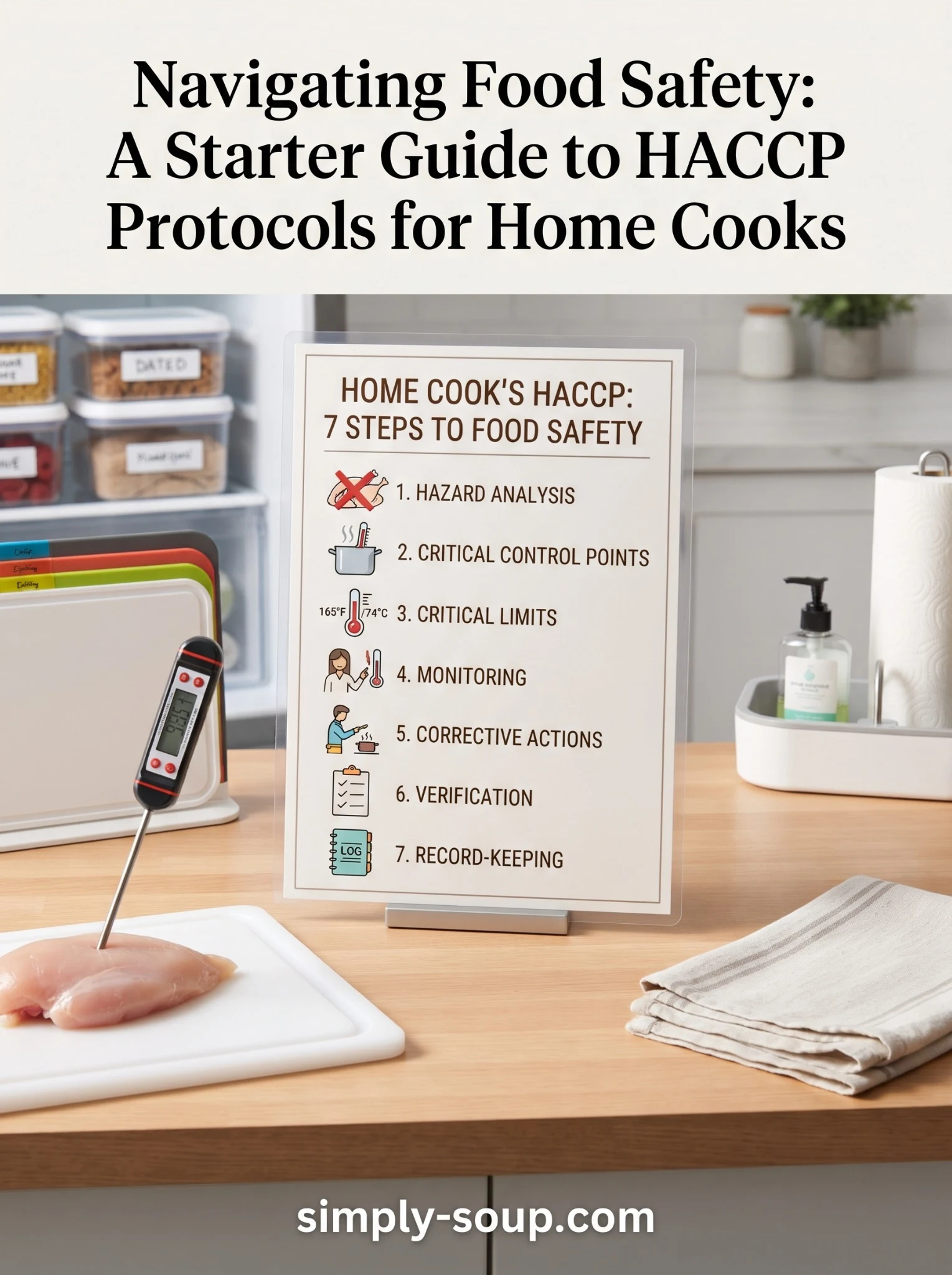
A clean kitchen, a labelled container and a food thermometer are small things with an important job. They help you answer practical questions: is the food cooked properly, has it cooled quickly enough, and can you tell which leftovers need using first?
HACCP gives those questions a structure. The initials stand for Hazard Analysis and Critical Control Point. It is a preventive approach: identify what could make food unsafe, decide how to control it, check that the controls work and act when something goes wrong.
This guide uses the seven principles in our pin as a starting point for safer soup-making at home. It follows UK household guidance where applicable. It is an introduction, not a completed HACCP plan or a food hygiene qualification.
Ordinary domestic cooking does not call for a commercial HACCP folder. You can still borrow its way of thinking. If you start supplying food regularly to the public, different responsibilities apply—even when the food is prepared in your home. See the business section below.
Start with the everyday basics
A formal HACCP system builds on good hygiene practices, sometimes called prerequisites. A temperature check cannot compensate for a dirty chopping board or a contaminated serving spoon.
- Wash hands with soap and water before preparing food and after handling raw ingredients, bins or pets.
- Keep raw meat and its juices away from cooked food, bread, salad and garnishes. Store raw meat securely covered below ready-to-eat foods.
- Use separate boards and utensils where possible, and clean thoroughly between tasks. Colour coding only helps if everyone follows the same system.
- Do not wash raw chicken: splashes can spread bacteria. Wash or prepare fruit and vegetables as directed on their packaging.
- Keep worktops, cloths and frequently touched handles clean. Clean and disinfect surfaces after raw-food contact, following the product’s dilution and contact-time instructions.
- Keep cleaning chemicals away from food and never decant them into food containers.
The Food Standards Agency’s cross-contamination guidance and cleaning guidance explain these foundations.
The seven principles, translated for a home kitchen
The sequence below follows the FSA’s MyHACCP framework and its introduction to the system. The examples illustrate the thinking; they do not designate formal critical control points for every recipe.
1. Analyse the hazards: what could cause harm?
Consider the ingredients, people eating and preparation steps. Hazards include harmful microorganisms, cleaning chemicals, hard fragments such as glass, and allergens. For a chicken soup, raw poultry is an obvious concern. For vegetable soup, contaminated produce, a slow-cooling pot or an unsuitable stock ingredient can still matter.
2. Identify critical control points: where is control essential?
In a formal system, a critical control point is a stage where a control is essential to manage a significant food safety hazard. Cooking may be one example. Not every useful kitchen task is a CCP: routine handwashing and cleaning normally belong among the hygiene foundations. The classification depends on the actual process.
3. Establish critical limits: what must be achieved?
Use a measurable, evidence-based boundary rather than “looks about right”. A cooking control might specify a temperature held for a stated time. In a business, limits must suit the product and process. At home, follow reliable recipe, packet and official guidance rather than inventing a limit.
4. Monitor: check at the right moment
Monitoring means observing or measuring the control while the work is happening. For example, use a clean probe to check cooking, or note when cooling started. Looking at yesterday’s fridge reading cannot tell you whether today’s batch was cooked adequately.
5. Set corrective actions: decide what to do if it fails
If food has not reached the cooking target, continue cooking and check again. If storage history is unsafe or unknown, do not assume another boil will rescue it. A corrective action deals with the affected food and the reason for the failure.
6. Validate, verify and review: is the approach sound?
Validation asks whether a planned control can manage the hazard. Verification checks that the system is actually being followed and works as intended. At home, that might mean checking the thermometer according to its instructions and reviewing whether your cooling arrangements suit the batch size. Businesses need evidence appropriate to their process.
7. Keep useful records
For household leftovers, a label with the dish name and cooking date is a useful start. You can also note cooling and reheating details. A business needs records proportionate to its operation, including problems and actions taken. A completed form is only useful if it accurately reflects what happened.
What the temperature in the pin means
The pin shows 165°F/74°C. This is consistent with the US Department of Agriculture’s 165°F minimum for poultry. It should not be read as the single rule for every ingredient or every cooking process.
For this UK-focused guide, the FSA’s household advice gives 70°C for 2 minutes in the middle of the food, or an equivalent combination such as 75°C for 30 seconds. Both the temperature and the holding time matter. These are food temperatures, not oven settings. Follow packet instructions too.
The photograph is illustrative: a probe inserted into a raw chicken breast does not establish that it has been cooked safely. Check after cooking, with a clean probe correctly positioned in the thickest part. For chunky soup, check substantial pieces as well as the stirred liquid; hot broth does not prove that the centre of a large piece is ready.
Cooking reference: FSA: cooking your food.
Using a probe without spreading contamination
Follow the thermometer maker’s instructions for insertion depth, response time, cleaning and accuracy checks. Clean and disinfect the probe appropriately before and after use, and between raw-food contact and checks of cooked food. Keep the sensing area away from the pan base and bone. An infrared thermometer measures surface temperature; it does not replace a probe for checking the centre.
Follow one batch from ingredients to leftovers
Imagine you are preparing a vegetable and chicken soup for supper and saving two portions. Think through the whole journey before switching on the hob. This is a household example, not a commercial process specification.
Before cooking: make room for the leftovers
Have clean, smaller containers ready and enough fridge space for the cooled portions. Check use-by dates and storage instructions. Keep raw chicken separate while preparing vegetables and garnishes. Do not return cooked food to an unwashed plate that held raw meat.
During cooking: check the food, not just the clock
Recipe times are guides: piece size, starting temperature and pan size affect cooking. Stir the soup so it heats evenly and check the thickest pieces with a probe. If a check fails, continue cooking, then check again with a cleaned probe. Serve with clean utensils.
After cooking: cool the saved portions promptly
A deep stockpot can stay warm in the centre for a long time. Divide the portions you are saving into smaller, shallow containers; a cold-water bath around suitable containers can help, without letting water enter the food. Do not leave the whole pan on the hob overnight.
FSA household advice is to cool cooked food and refrigerate it within one to two hours. Avoid putting a large hot pot in the fridge: it can warm surrounding food. Plan the batch so you can cool it promptly, rather than waiting indefinitely for a large quantity to reach room temperature.
In the fridge: use time and temperature together
Keep your fridge between 0°C and 5°C, checked with a fridge thermometer. Label the soup and use refrigerated leftovers within 48 hours, or freeze them. Defrost in the fridge and use within 24 hours of full defrosting. Freezing does not make mishandled food safe.
Storage reference: FSA: chilling, freezing and defrosting. Our soup freezer guide adds practical portioning ideas.
When reheating: heat the portion thoroughly
Reheat only the amount you need, until steaming hot throughout, stirring so cold areas are not missed. Reheat leftovers only once. For a microwave, follow instructions on stirring and standing time; a hot bowl or bubbling edge does not show that the centre is hot. Serve promptly after reheating.
Reheating reference: FSA: safe method for reheating.
Allergens need their own attention
A safely cooked soup can still be unsuitable for someone with a food allergy. Stocks may contain celery or wheat; plant creams may contain soya or nuts; toppings can introduce milk, sesame or other allergens. Check the actual packets, including when changing brands.
Agree requirements with the person eating, keep ingredients and utensils appropriately separated, and prevent cross-contact. Removing a topping after it touches the soup does not reliably remove its allergen. Heating is not a dependable way to destroy food allergens. If you cannot establish that a dish is suitable, say so rather than guessing.
Reference: FSA: allergen cross-contact controls.
A simple home soup safety checklist
- Before: check ingredients, dates and dietary needs; clear preparation space; set out clean containers.
- Prepare: wash hands, separate raw and ready-to-eat foods, and clean equipment between tasks.
- Cook: follow instructions, stir where appropriate and check the relevant food temperature and time.
- Serve: use clean utensils and keep raw-food equipment away from finished soup.
- Save: divide leftovers, cool promptly, label and refrigerate within the household guidance above.
- Reheat: heat only the required portion thoroughly and only once.
- Review: if a step went wrong, decide whether the food must be discarded and change the arrangement for next time.
For your own notes, use four short prompts: “What did I make?”, “When was it cooked and chilled?”, “When must I use it?”, and “Has it already been reheated?” This is a household memory aid, not a business record template or a guarantee of safety.
Thinking about selling soup from home?
Once food is supplied regularly and on an organised basis to the public, including some free provision, you may be operating a food business. In England, Wales and Northern Ireland, official guidance says to register with the local authority at least 28 days before starting. Contact your local environmental health team to discuss your actual activities and premises; Scotland has its own supporting guidance and tools.
A food business needs appropriate food safety procedures based on HACCP principles. These must reflect what you actually do: ingredients, batch sizes, cooking, cooling, storage, transport, service and allergen information. Household leftover guidance is not a validated commercial cooling method or a shelf-life study. Changing from a small saucepan to a large stockpot can change the risks substantially.
The FSA’s Safer food, better business catering pack is a practical starting resource for small catering operations. Ask your authority which pack or system suits your location and business. Training, records and a suitable kitchen all matter; buying a thermometer or completing this checklist is not certification.
Our Simply Soup Business Startup Bundle can help organise planning, costs and records, but it does not replace a suitable food safety management system, local requirements or training.
Business references: starting a food business; food safety management systems.
Frequently asked questions
Does vegetable soup need the same care?
It still needs safe handling, cooking where required, prompt cooling and appropriate storage. Meat-free ingredients do not remove all microbiological hazards, and allergens may still be present. Follow the same leftover routine for our lentil and kale soup and tomato basil bisque.
Can I boil soup that was left out overnight?
No—discard it rather than trying to rescue it. Reheating is not a reliable correction for unsafe storage; some hazards, including certain bacterial toxins, may remain. Do not taste it to decide whether it is safe. USDA explains why reheating may not destroy toxins formed during unsafe storage.
Must every kitchen check be called a CCP?
No. Good hygiene practices support the system, while formal CCPs are identified through analysis of significant hazards and the controls needed for a particular process. Calling every task a CCP makes the distinction less useful.
Do I need expensive equipment?
Useful basics are a suitable food probe, fridge thermometer, clean food-safe containers and labels. Choose equipment you can clean and use correctly. More equipment does not replace careful handling or following instructions.
Can I use this article as my business HACCP plan?
No. It explains the principles and household examples. A business system must address its own process and be implemented, checked and maintained. Use official resources and local authority advice for that next step.
The most useful habit is to look beyond the moment of cooking. A safe bowl depends on what happened before it reached the pan, how it was handled afterwards and whether the checks reflect what actually happened.