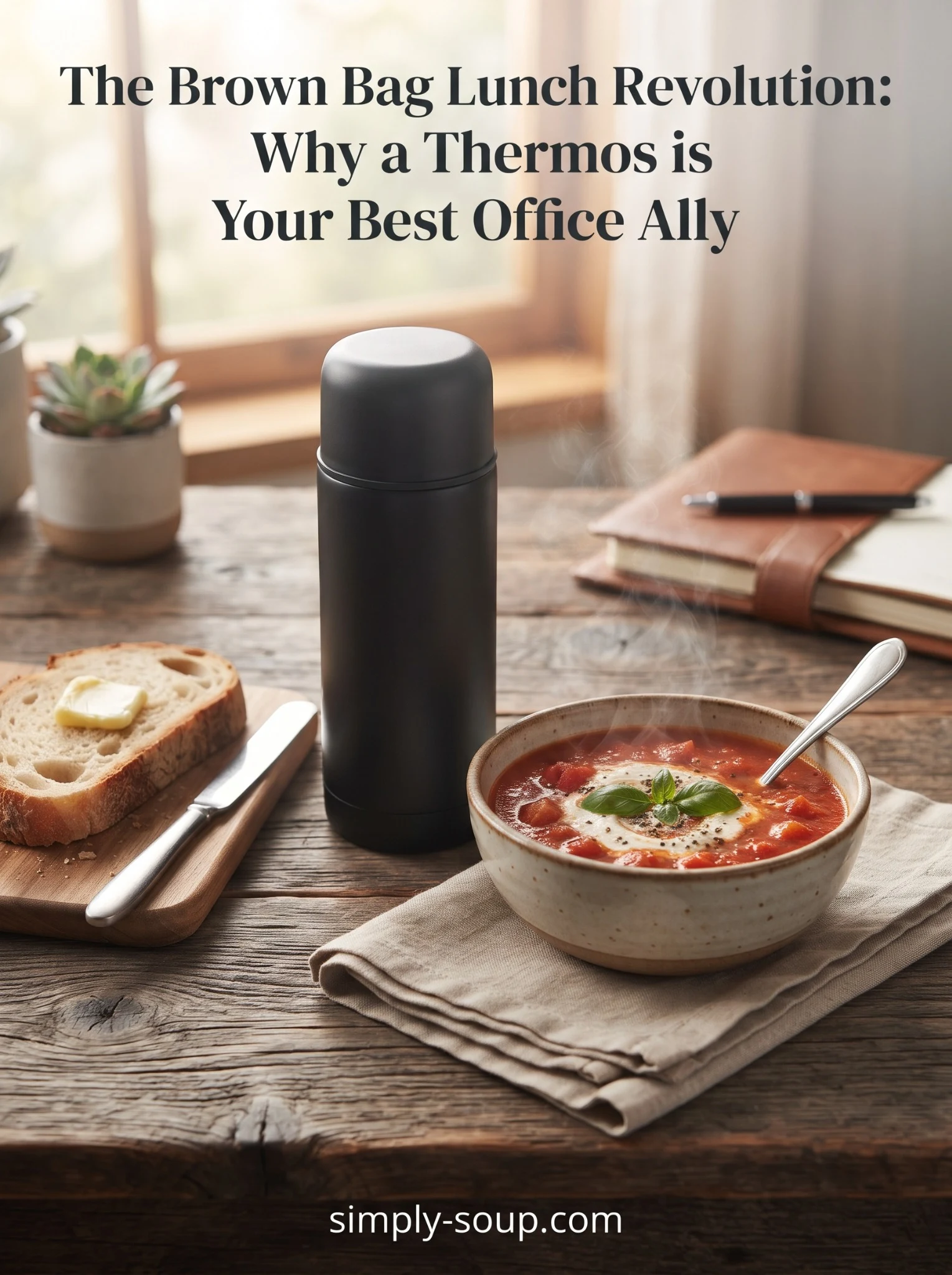
It is nearly lunchtime. Your inbox is still busy, the weather is uninviting and the usual sandwich suddenly feels rather uninspiring. Now imagine opening a flask of tomato and basil soup, unwrapping a slice of bread and taking a proper break. A little preparation has brought something warm and familiar into the working day.
That is the appeal behind our pin: a simple bowl of soup, a flask and a quiet corner of the desk. You do not need an elaborate lunch system or five identical meal-prep boxes. One reliable soup, the right container and a sensible packing routine can be enough to start.
A food flask can be especially useful when the office microwave is busy, the staff kitchen is limited or your break falls outside normal café opening hours. But insulation is not magic. A flask slows temperature change; it does not cook cold food, reheat leftovers or guarantee a safe lunch regardless of how it was packed.
From laboratory equipment to the lunch bag
The vacuum flask began with a scientific problem rather than an office lunch. Thermos’s own history traces the vacuum flask to Scottish scientist Sir James Dewar in 1892 and the first Thermos consumer products to 1904. The underlying idea was to reduce heat transfer using a gap between two walls from which much of the air had been removed. You can read the brand’s account of that development.
Modern insulated containers use that principle to slow warming or cooling. Their performance also depends on the lid, construction, condition and how they are used. “Thermos” is often used conversationally for a vacuum flask, but Thermos is also a brand name. This guide is about choosing and using a suitable insulated food container, rather than recommending one particular brand.
Why soup deserves a place in your working lunch
Soup is flexible. You can make a vegetable-led bowl, a substantial lentil lunch or a smooth tomato soup that fits neatly beside a sandwich. It also gives you a useful destination for planned portions of home cooking, so you are not starting lunch from scratch every morning.
Preparing your own lunch lets you choose its ingredients and portion size. That does not automatically make every homemade soup healthier or cheaper than every shop-bought lunch. Cream, salty stock, generous toppings and oversized portions still count. The advantage is that you can adjust the meal to suit your preferences rather than accepting whatever happens to be available.
A warm lunch can also make a break feel more deliberate. If possible, put the work aside for a few minutes, sit comfortably and enjoy it. Soup is a meal worth eating without balancing the bowl above your keyboard.
Choose a food flask, not just an attractive bottle
The tall black flask in the image sets the scene, but a narrow drinks bottle may be awkward for thick or chunky soup. A wide-mouth food jar generally makes filling, spooning and cleaning easier. Before buying, consider the lunch you actually want to carry.
| Feature | What to check | Why it matters |
|---|---|---|
| Opening | Wide enough for a spoon and cleaning brush | Chunks should pass through comfortably |
| Usable capacity | Your usual portion, allowing the specified headspace | A very large jar may be poorly matched to a small lunch |
| Lid and seal | Instructions for closure and removable parts | Correct assembly helps prevent leaks |
| Heat retention | Exact model’s guidance and test conditions | A headline number does not describe every packed lunch |
| Cleaning | Access to threads, seals and the inside | Trapped food makes daily cleaning difficult |
| Practical use | Weight, grip and whether a spoon fits inside | The flask should work with your commute and lunch bag |
Measure a normal serving in a jug before choosing capacity. Remember that the advertised volume may not equal the recommended fill volume. Buy for your appetite and the manufacturer’s filling instructions, rather than assuming the biggest jar is best.
Check whether the lid is intended to double as a bowl, whether parts are dishwasher-safe and whether replacement seals are available. Those details can matter more in daily use than a fashionable colour. No particular product has been tested or endorsed for this article.
A safe morning packing routine
Start by choosing one of two approaches: keep soup properly hot until you eat, or transport it properly chilled and reheat it at work. Avoid the uncertain middle ground of packing lukewarm soup and hoping it will be fine several hours later.
1. Begin with correctly stored soup
For UK household cooking, Food Standards Agency guidance recommends cooling cooked food promptly, dividing large amounts into smaller containers and refrigerating within one to two hours. Keep the fridge at 0–5°C, eat leftovers within 48 hours or freeze them. Follow the official chilling and freezing guidance, including thawing advice.
Do not leave yesterday’s pot on the hob overnight. Good flask packing cannot undo poor storage. Our soup freezing and portioning guide will help you organise batches into useful lunch portions.
2. Preheat the container as directed
Follow the instructions for your exact food jar, including the water temperature, preheating time and handling precautions. Manufacturer guidance varies, so do not assume every flask should be treated identically. Empty the preheating water just before filling with food.
Place the flask on a stable surface and keep fingers clear of hot water and steam. Preheating helps reduce the amount of heat the cold container takes from your soup; it does not replace thoroughly heating the food itself.
3. Reheat the soup thoroughly
Reheat only the portion you need until steaming hot throughout, stirring to distribute heat. The FSA advises reheating leftovers only once. If using a microwave, follow instructions for stirring and standing time; a hot edge does not prove that the centre is hot. See the official guidance on cooking and reheating.
Use a saucepan or a suitable microwave-safe container. Never put a metal flask in a microwave. The flask is for retaining heat after heating, not for bringing chilled soup up to temperature.
4. Fill promptly, seal and keep closed
Transfer the hot soup promptly, staying within the manufacturer’s fill line and leaving the required headspace. Wipe the rim, fit the lid correctly and keep the container upright in your bag. Keep it closed until the meal; repeated opening releases heat.
Pack bread and dry toppings separately. If you take yoghurt, cheese or another perishable accompaniment, keep that chilled in its own suitable arrangement. Adding a cold garnish to the hot soup in the morning can lower its starting temperature.
5. Check performance before relying on it
For this UK-oriented guide, use 63°C or above as a cautious hot-holding benchmark when checking your setup. That temperature comes from UK guidance for food businesses; it is used here as a practical reference, not as a claim that an office lunch is a commercial operation.
On a trial day, use your usual soup quantity, packing method and expected interval before lunch. At mealtime, stir carefully and measure with a clean food thermometer. A result at or above the benchmark gives useful evidence for those conditions, but a colder day, a smaller portion or a longer delay may change the result.
If the soup is below the benchmark and you do not know how long it has been cooling below it, discard it rather than guessing. Do not rely on smell, taste or the warmth of the outside of the flask. If your setup cannot reliably hold lunch hot for the required time, take it chilled with effective cold packs, refrigerate on arrival where possible and reheat once when you are ready to eat.
Which soups travel well?
Choose something you enjoy that is easy to spoon and does not depend on a delicate garnish. Fully cook the ingredients before packing: the flask is not a dependable cooking method for raw vegetables, dried pulses, meat or pasta.
- Tomato and basil: a smooth or lightly textured soup works well beside bread. Our roasted tomato basil bisque offers a comforting starting point inspired by the pin.
- Lentil and vegetable: substantial enough for lunch, with small pieces that fit comfortably on a spoon. Try our country lentil and kale soup.
- Carrot and white bean: blend cooked carrots and cooked beans into stock for a smooth texture, then season to taste. Beans add body without requiring a cream finish.
- Chunky vegetable: cut pieces fairly evenly and avoid oversized chunks that make serving awkward. Our vegetable soup formula helps you build a balanced pot.
- Courgette and lemon: a lighter option for warmer days. See the recipe in our seasonal soup menu guide.
Pasta can continue absorbing liquid while it sits, making a soup thicker and the pasta softer. Test a small batch before preparing a whole week’s lunches. For simplicity, begin with a soup that does not contain rice or pasta, then experiment once you know your flask routine works.
Keep croutons, seeds and fresh herbs separate until serving. If you like cream or yoghurt on top, add it at the table from a safely chilled container. A good travelling soup should still taste satisfying without an elaborate collection of extras.
Could a soup lunch save money?
It can, especially when it replaces a lunch you would otherwise buy. But the useful comparison includes the whole meal, not just the vegetables in the pot. Include bread, toppings, cooking costs and ingredients that get wasted.
Illustrative example only: suppose a bought lunch costs £6 and your homemade soup, bread and allocated cooking costs total £2 per serving. These are round assumptions, not surveyed prices or promised savings.
| Calculation | Example result |
|---|---|
| £6 bought lunch minus £2 homemade lunch | £4 saved per replacement lunch |
| Three replacement lunches per week | £12 per week |
| Four weeks at that frequency | £48 before buying equipment |
| Assumed £24 food flask ÷ £4 saving | Six lunches to recover the flask cost |
Use your own receipts to repeat the calculation. If you normally take an inexpensive sandwich, the financial difference may be small. If you buy soup ingredients but still purchase lunch because you forget to pack it, there is no saving. A routine you use twice a week is more valuable than an ambitious plan you abandon.
A weekly routine that leaves room for real life
Start with two or three soup lunches rather than committing to every working day. Choose a soup you already know you enjoy, then put its ingredients on the normal shopping list. The aim is to reduce decisions on busy mornings.
- Cook one manageable batch. Make enough for dinner and a few planned lunch portions, rather than filling every saucepan.
- Cool and portion promptly. Label containers with the soup name and date. Refrigerate portions for the next 48 hours and freeze later ones.
- Plan the next lunch the evening before. Move a frozen portion to the fridge in time to thaw safely. Put out the clean flask, spoon and lunch bag.
- Pack using the same morning sequence. Preheat the flask as instructed, reheat the soup thoroughly, fill and close.
- Wash up that evening. A clean, dry flask makes tomorrow’s lunch much easier to organise.
For night shifts or irregular breaks, count the actual hours from packing to eating. A flask filled before an evening commute may face a much longer wait than one packed for an ordinary midday lunch. If a break is unpredictable, reliable refrigeration and reheating may suit you better.
Cleaning, leaks and other everyday problems
Empty and clean the flask after use, following its care instructions. Remove seals only if designed to be removed, wash accessible parts thoroughly and check the lid threads for trapped food. Rinse and dry fully; store with the lid off if the manufacturer recommends it.
Do not assume every component can go in the dishwasher. Check the body, stopper, seals and any folding spoon separately. Replace damaged parts when appropriate, and stop using a container with a compromised lining or an unreliable closure.
- Soup is cooler than expected: check the starting temperature, preheating method, fill level and interval before lunch. Do not solve the problem by trusting a warm taste test.
- The flask leaks: inspect the gasket, threads and fill level. Test correct assembly with cool water over a sink before putting it back into a work bag.
- The soup is too thick: adjust with a little stock before reheating thoroughly. Do not add cold liquid after packing.
- The lid smells: inspect removable seals and hidden food traps. Follow the manufacturer’s cleaning advice rather than using an abrasive or chemical treatment at random.
- The lunch feels too small: add a suitable side or reassess portion size. A larger container only helps if you can fill and use it appropriately.
Frequently asked questions
How many hours will a flask keep soup safe?
There is no single answer for every flask and meal. Model, quantity, initial temperature, preheating, opening and surroundings all matter. Follow the specific instructions and check performance across your actual packing-to-lunch interval.
Can I pack the flask the night before?
For a hot lunch, refrigerate the soup safely overnight and heat it just before packing in the morning. Do not rely on overnight hot holding followed by another several hours until lunch.
Can I use a drinks flask for smooth soup?
Possibly, if the manufacturer permits that use and it can be cleaned properly. A wide-mouth food jar is usually easier for spooning, filling and chunky ingredients. Check the exact model rather than relying on its appearance.
Can I save what is left in the flask for tomorrow?
Pack only what you expect to eat and discard uneaten flask leftovers after the meal. Avoid taking partially eaten, cooling soup home for another reheating cycle.
Does vegetable soup need the same care as meat soup?
Yes. Cooked vegetables, pulses and other plant-based ingredients also need proper temperature control. Removing meat does not make a packed soup safe to leave lukewarm.
What should I pack alongside it?
A spoon, napkin and separately wrapped bread are a useful start. Add fruit or another side according to your appetite. Perishable extras need their own cold storage, and a stable bowl can be easier than eating directly from a tall container.
Make one lunch easier this week
Choose one favourite soup, measure your usual portion and check the food flask instructions. Then try the routine on a day when your break is predictable. Keep what works, adjust what does not and build from there.
If your interest in soup grows beyond your own lunch bag, our Simply Soup business blueprint explores planning a small soup venture. You can view the complete package on Payhip. Selling food requires appropriate business procedures; this household lunch guide is not a commercial food-safety plan.
Food-safety and historical sources checked on 3 November 2026. Household guidance is UK-oriented; follow local advice and your container’s instructions.