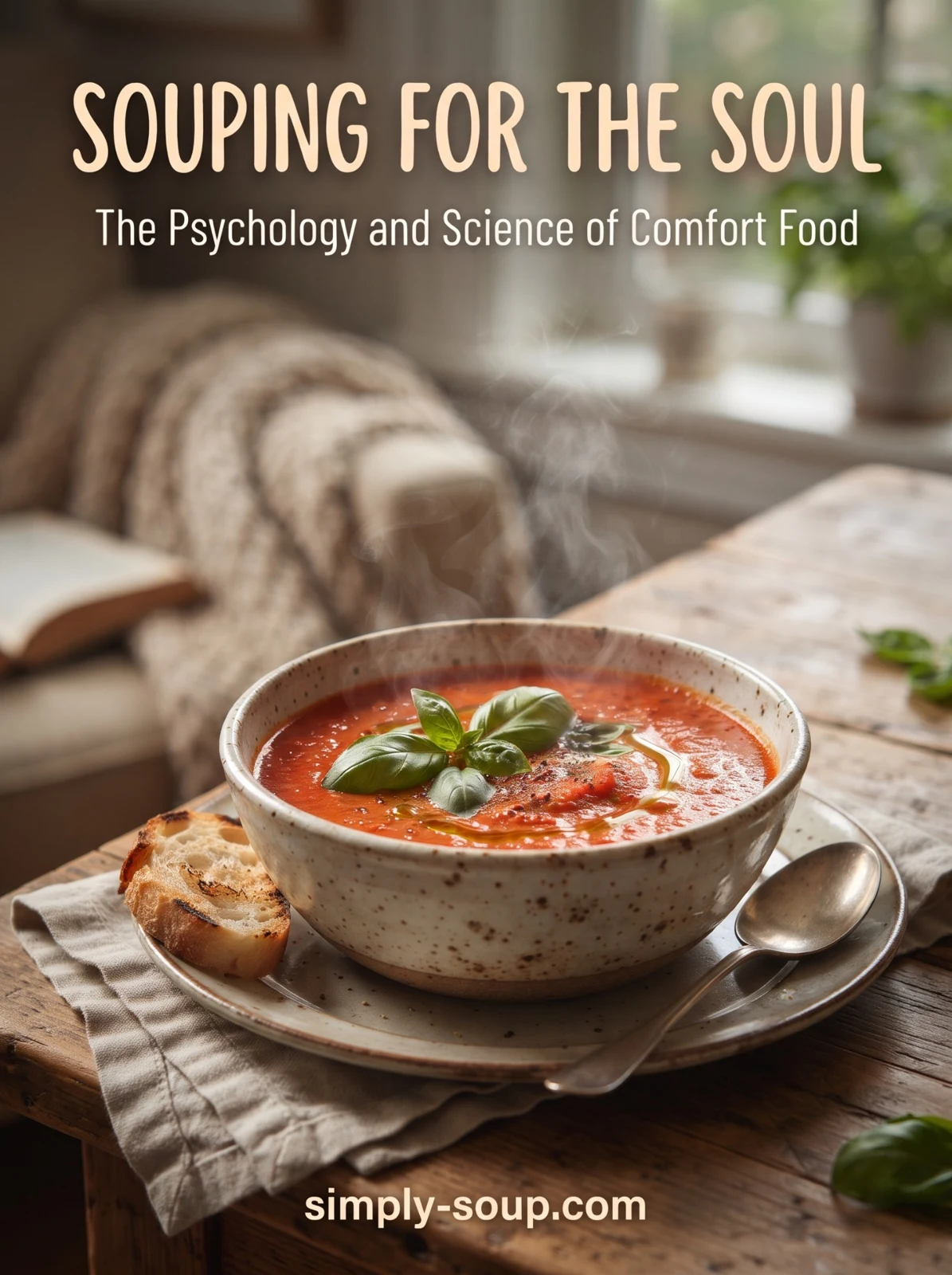
A bowl of tomato soup, a piece of toast and a quiet place to sit: sometimes that is the meal you want most. The scene in our Pinterest pin captures something familiar. It is not an extravagant dinner. It is a warm bowl, a comfortable chair and permission to pause.
Why can food feel so personal? The psychology of comfort food offers some interesting possibilities, especially around memory and relationships. The evidence also asks us to be careful: enjoying a comforting meal is not the same as proving that a particular food reliably changes our mood.
Soup is a lovely way to explore that distinction. It can be familiar, adaptable and easy to share. It can also simply taste good. None of those pleasures needs an exaggerated promise about hormones, stress or healing.
Comfort food is personal
Ask a few people to describe their most comforting meal and you may hear very different answers. One might choose tomato soup from a tin. Another might remember a grandparent’s lentil soup, a noodle broth or a thick vegetable stew served after a day outdoors.
Think about your own choice. Is it the flavour you want, or the situation it brings to mind? Perhaps it is the person who used to make it, the room where you ate it or the knowledge that dinner required no decisions from you.
These are useful questions, not a test with a correct answer. You do not need a childhood memory to enjoy soup today, and a family favourite does not have to become your favourite. A new routine can be pleasant in its own right.
Why an aroma can take you somewhere else
The smell of tomatoes simmering with garlic may remind you of a particular kitchen before you have even tasted the soup. Research on smell and autobiographical memory gives us a reason to take that experience seriously.
In a 2002 study, Rachel Herz and Jonathan Schooler compared personal memories prompted in different sensory contexts. Memories recalled with an odour cue were more emotional than those associated with the corresponding visual or verbal cue, and participants tended to feel more transported back to the event. Read the study abstract.
This was not a soup experiment, and it does not establish that every familiar smell is pleasant. A reasonable interpretation for the kitchen is that an aroma can contribute to the emotional meaning of a meal. It is not evidence that smelling basil or onions automatically releases a particular “happiness chemical”.
The people behind the bowl
A meal can stand for an act of care: someone noticing you were hungry, bringing you lunch or making enough for another person. That is part of what makes the idea of comfort food interesting to psychologists.
In 2011, Jordan Troisi and Shira Gabriel investigated associations between comfort food and relationships. Their experiments suggested that comfort food could activate relationship-related ideas, and that thinking about it could help buffer a threat to belonging for people with secure attachment styles. The findings were conditional, rather than a claim that chicken soup makes everyone less lonely. Read the original research summary.
A later replication project by Ong and colleagues, published in 2015, did not confirm the overall effect across its American, Dutch and Singaporean samples. The authors discussed possible cultural differences, but treated their exploratory explanations cautiously. Read the replication study.
The practical takeaway is modest: a food may carry social meaning for you, but there is no universal bowl that replaces human connection. Sharing lunch with someone and enjoying a remembered flavour are different experiences, even when both matter.
Does comfort food actually improve mood?
One important study complicates the popular story. In The Myth of Comfort Food, published in 2014, Heather Scherschel Wagner and colleagues used films to induce negative moods, then compared participants’ chosen comfort foods with other foods or no food.
Mood improved after comfort food, but it also improved in the comparison conditions. The comfort foods did not produce a greater short-term improvement. That suggests we can sometimes credit the food for a change that might have happened with time anyway. Read the study abstract.
It would be too broad to turn those laboratory findings into “food never comforts anyone”. The study addressed a particular question about short-term mood recovery, not every family meal or every enjoyable eating experience.
What makes soup an inviting choice?
Look again at the pin: red tomato soup, fresh basil, a spoon within reach and bread on the side. It suggests a complete, manageable moment. You can borrow that idea without recreating the photograph.
Soup gives you choices. You can make it smooth or chunky, keep the flavour mild or add spice, eat it at a table or take it to work in a suitable container. For some people, a warm bowl feels welcome on a cold day. For others, texture, flavour or familiarity matters more than temperature.
Those are reasons to explore your preferences, not proof of a special therapeutic effect. Serve soup at a comfortable temperature, rather than treating hotter as better, and choose ingredients you actually enjoy.
Build a soup ritual that fits your day
The following ideas are practical invitations, not a researched treatment programme. Choose one or two that sound appealing and leave the rest.
Start with the familiar
Pick a flavour you already like. That might be tomato and basil, leek and potato, or a simple vegetable broth. You do not need a new recipe every week. Repeating a favourite can make meal planning easier.
If you want to experiment gently, our four-step master formula helps you choose a base, liquid, flavour and body without making the process complicated.
Make the setting comfortable
Use a bowl that is pleasant to eat from. Bring a spoon, bread and any topping to the table before you sit down. If you would enjoy a few quiet minutes, put your phone aside. If company sounds better, invite someone to join you.
The setting does not have to look styled. A clear corner of the kitchen table can be enough. Let the pin inspire a feeling rather than a shopping list.
Keep preparation realistic
There are days for slowly making stock and days for opening a tin. Both can result in a meal you enjoy. You might add a little basil, serve toast alongside it or simply eat it as it comes.
If a ready-made portion would make tomorrow easier, our ultimate freezer guide covers batch-cooking, labelling and storage. Preparing food ahead is a practical convenience; it does not need to become another demanding project.
Share the care, if you want to
You could make enough for a shared lunch or ask someone which soup they remember fondly. If giving a portion away, check their preferences and allergies and include clear storage instructions. The thoughtful part is paying attention to the person, not making the most impressive recipe.
Give yourself room to enjoy the meal
You do not have to justify a favourite soup with a scientific explanation. Nor do you need to turn comfort food into a reward you must earn. A meal can be enjoyable, ordinary and useful all at once.
Soup also need not carry the whole task of making a difficult day better. It may accompany a rest, a conversation or some time away from work. Keeping those expectations modest makes more sense than asking one bowl to solve everything.
Perhaps your next comforting meal will be the tomato soup in the picture. Perhaps it will be a hearty beef and vegetable soup, or a combination you invent yourself. The most useful question is simply: what would you enjoy eating today?
Frequently asked questions
Is soup scientifically proven to make everyone feel better?
No. The studies discussed here do not establish a universal mood benefit from soup. Personal enjoyment is real, but it should not be confused with a guaranteed psychological effect.
Why does a familiar food remind me of home?
Food can be associated with people, places and past experiences. Research on odour-cued memory offers one possible part of the explanation, although memories and reactions differ between people.
Does comfort food have to be rich or indulgent?
There is no need to choose food by how elaborate it is. If a plain broth or vegetable soup is what you enjoy, that is a perfectly reasonable choice.
Does homemade soup count more than tinned soup?
No. You may enjoy the process of cooking, or prefer the convenience and familiarity of a ready-made soup. Neither needs to win a contest to deserve a place at your table.
Research linked above: Herz & Schooler (2002), American Journal of Psychology; Troisi & Gabriel (2011), Psychological Science; Wagner et al. (2014), Health Psychology; Ong et al. (2015), Frontiers in Psychology. The practical suggestions are editorial ideas, not outcomes demonstrated by these studies.