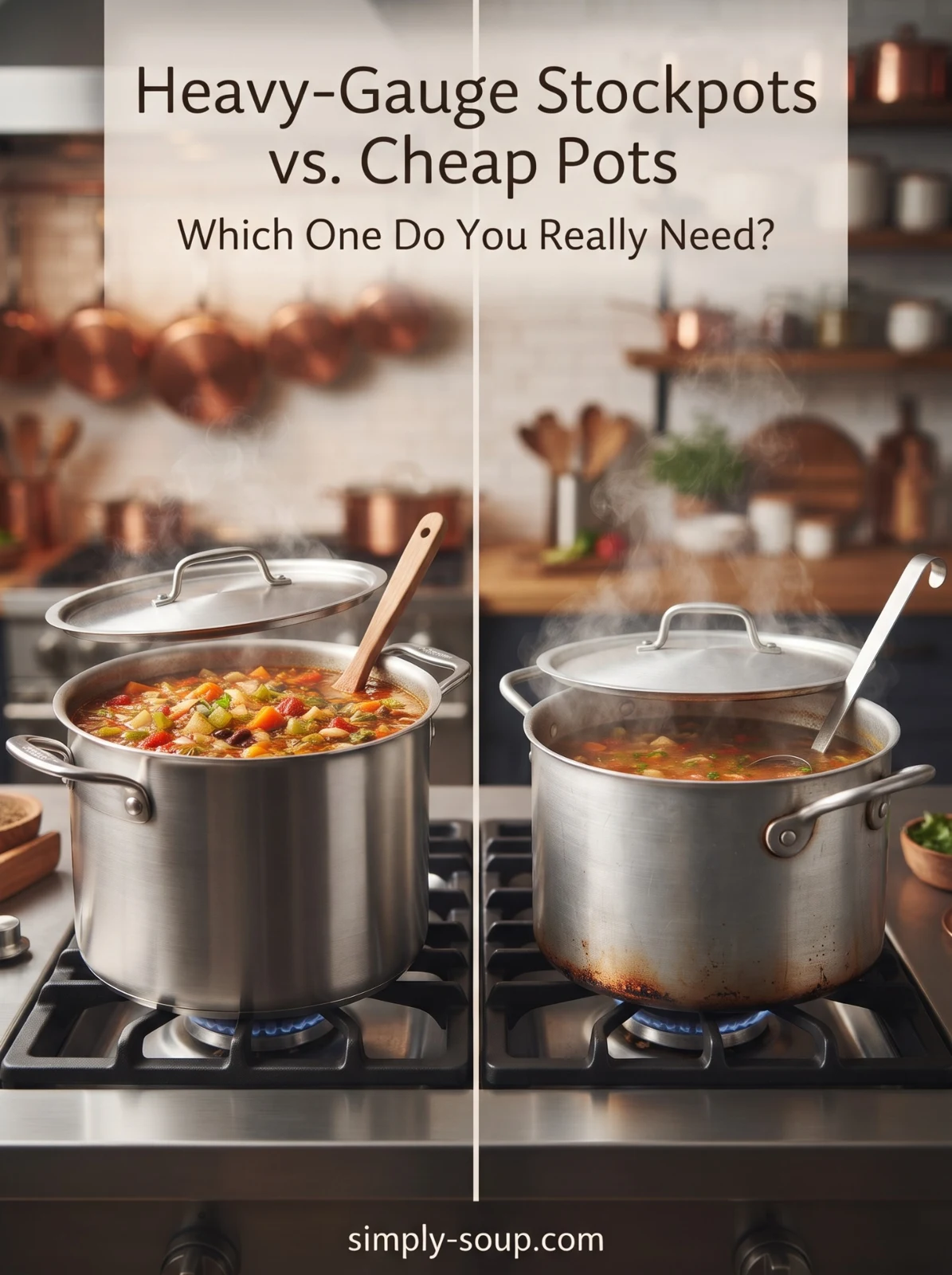
There is something reassuring about a substantial soup pot: the solid handles, the snug lid, the feeling that it will see you through years of winter lunches. But does a heavier pot actually make better soup? And is an inexpensive one quietly letting your cooking down?
You do not need an expensive stockpot to make lovely soup. A well-made, heavier base can make cooking more forgiving, particularly when you soften vegetables or simmer a thick soup. For a roomy pot of watery stock, a simpler, lighter pot may already do everything you need.
The useful question is what you cook, how often you cook it, and whether your current pot causes a problem. This is a practical buying guide, not a hands-on test of particular products.
What does “heavy-gauge” actually mean?
In everyday cookware descriptions, heavy-gauge generally means thicker metal. Unfortunately, the phrase alone does not tell you how a pot is constructed, how evenly its base heats, or how pleasant it will be to lift. An expensive price tag does not answer those questions either.
Look for the details behind the description. Stainless steel is durable and practical, but manufacturers often combine it with a more conductive metal such as aluminium to help spread heat. That layer might sit in a bonded disc beneath the pot, or continue up the sides in fully clad construction.
For an example of what a clear specification looks like, All-Clad describes its D3 construction as stainless steel bonded around an aluminium core extending to the rim. That explains the materials; it is not proof that everyone needs that particular pot.
A well-designed base is particularly useful when the bottom of the pot does most of the cooking. Fully clad sides can be a nice feature, but they are not a requirement for a good bowl of soup. Equally, a lightweight pot made from a conductive material is not automatically worse than a heavier pot made from a different metal.
Where a heavier base earns its keep
Think about the first ten minutes of making soup. You soften onions, cook carrots and celery, or stir in tomato purée before adding the stock. At this stage there is little liquid to carry heat around. A base that spreads heat well can help reduce concentrated hot spots and give you more control over browning.
It can also help with thick lentil soups, bean soups and creamy mixtures that need attention at the bottom. As soup thickens, stirring and sensible heat become especially important. A heavy base offers some breathing room; it does not make food impossible to scorch.
There is a trade-off. More metal means more weight, and a substantial base can hold heat after you turn the hob down. If a soup starts catching, lowering the setting may not stop the cooking immediately. Move the pot off the heat safely and stir, rather than expecting the metal to cool at once.
When an inexpensive pot is perfectly sensible
Clear stock and broth contain plenty of liquid that circulates as it heats. If your pot sits securely, has sound handles and holds a gentle simmer reliably, you may gain very little by replacing it simply because another one feels more luxurious.
A lighter pot can also be easier to wash, store and lift. For occasional soup-making, or as a second pot for a large batch of stock, those practical advantages matter. Wear marks on the outside are not, by themselves, evidence of poor cooking performance.
If you enjoy making clear beef broth, concentrate first on a gentle simmer and careful straining. A dramatic rolling boil will not become gentler just because the pot cost more.
Match the pot to the job
| Your usual cooking | What matters most | Worth upgrading? |
|---|---|---|
| Broth and clear stock | Capacity, secure handles and a steady simmer | Only if your current pot struggles with these basics |
| Vegetables softened in the same pot | A base that spreads heat well | Useful if onions repeatedly catch in hot spots |
| Thick lentil or bean soup | Even heating, low heat and regular stirring | A better base may make cooking more forgiving |
| Occasional small batches | A manageable size and easy cleaning | A saucepan you already own may be enough |
| Large freezer batches | Safe lifting weight, hob fit and storage space | Choose usable capacity before maximum size |
Five things to check before you buy
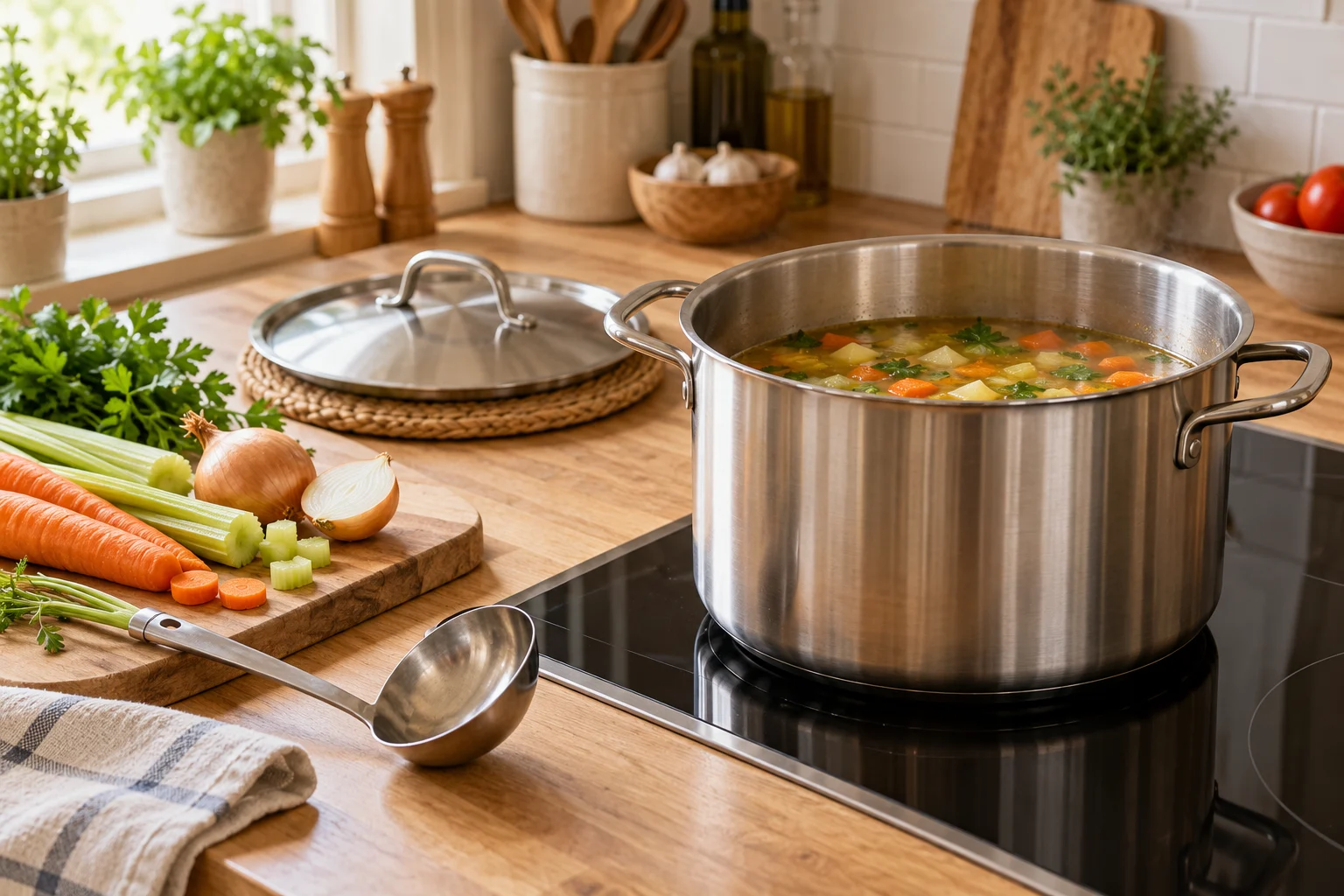
1. Choose a size you will actually use
Work backwards from your normal batch. If you typically make two litres of soup, a pot with a nominal capacity of only two litres leaves no useful stirring room. Allow space above the ingredients, and follow any maximum-fill guidance from the manufacturer.
Do not buy the largest pot just in case. Check that it fits your hob, sink and cupboard. For freezer cooking, two manageable batches can be more convenient than one enormous pot. Our freezer guide helps with the portioning and storage side of the plan.
2. Think about the weight when it is full
A litre of water weighs about a kilogram, so a large batch adds considerable weight before you count the pot itself. Try holding an empty pot with both hands before buying in person. Can you grip the handles comfortably with oven gloves? Can you reach them without brushing another pan?
Secure, roomy handles are more useful than impressive-looking metalwork. Do not assume handles stay cool. If lifting a full pot would be awkward, choose a smaller size and ladle soup into manageable containers.
3. Check your hob compatibility
For induction, look for an explicit compatibility statement. Zanussi explains the magnetic-base requirement: a magnet sticking to the underside is a useful initial check. The base size must also suit your hob’s requirements; the word “stainless” alone does not guarantee compatibility.
A stable, flat base matters too. Check your appliance manual for suitable cookware sizes. On gas, use a burner that fits the base and keep flames from licking up the sides.
4. Read the construction details
Look for a description of the base and metal layers, rather than judging by total weight or the number of layers alone. If a shop listing says only “premium heavy duty”, it has not told you much. A straightforward stainless pot with a well-made heat-spreading base may be all your soup kitchen needs.
5. Check the ordinary, everyday details
Does the lid fit neatly? Is the interior easy to reach with a spoon? Are there awkward corners to clean? Check the maker’s cleaning and oven-use instructions, including limits for handles and lids. These small details affect every batch long after the excitement of buying something new has passed.
Before replacing your pot, try this
Start your next soup with moderate heat and give the onions time. Add a small splash of water if the vegetables threaten to catch. Once the stock is in, bring the soup up to temperature, then reduce the heat to the simmer you need.
Stir across the bottom and into the corners, especially as beans, lentils or potatoes thicken the mixture. If the soup becomes too thick, add a little suitable liquid. Avoid heating an empty pot aggressively, and let it cool before cleaning according to its instructions.
If these changes solve the problem, keep your money. If the same area still scorches regularly at sensible heat, the pot rocks on the hob, or its handles are insecure, you have a concrete reason to repair or replace it. Stop using a pot with a loose handle until it has been made secure.
Common questions
Do I need a stockpot, or will a saucepan do?
A saucepan is fine for a batch that fits comfortably. A stockpot mainly gives you greater capacity, often with two side handles. Neither the name nor the height guarantees better soup.
Is cast iron better than stainless steel?
It depends on your priorities. An enamelled cast-iron casserole can be pleasant for slow cooking, but it is heavy before you add soup. Stainless steel can be easier to handle in larger sizes. Choose the weight, capacity and care requirements that work for you.
Will an expensive pot stop soup sticking?
No. Good construction can help distribute heat, but thick soup can still catch. Heat level, cooking time, stirring and the amount of liquid all matter.
What would we choose for a simple soup kitchen?
A manageable pot with secure handles, a lid and a base suited to the hob. If buying new for frequent soup-making, a well-constructed heat-spreading base would be high on the list. A premium badge would not.
Sources: the manufacturer construction and induction guidance linked above support the relevant technical points. This guide contains no paid product recommendations or affiliate links.