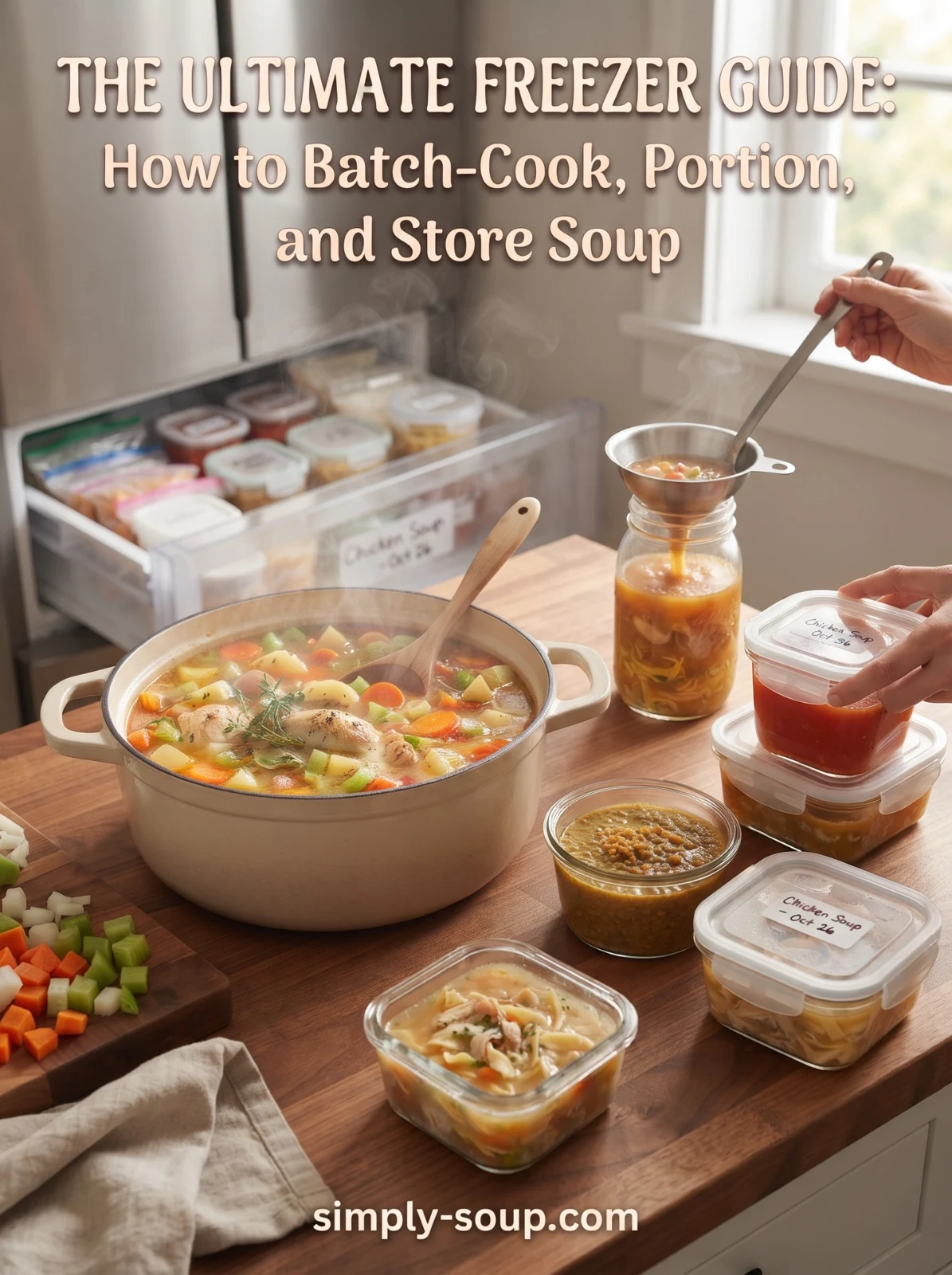
A freezer full of homemade soup is useful only if you can find the right portion, know what is in it and turn it into lunch without a long defrosting job. A little planning before you cook makes all three much easier.
The labelled containers in our Pinterest pin show the aim: organised portions that are ready for another day. There is one important detail to keep in mind, though: the image is inspiration, not a cooling demonstration. Do not put a steaming stockpot into the freezer or pour hot soup into ordinary glass jars. Cool the soup promptly and use containers intended for freezing.
This guide takes you from choosing a batch to serving it again, with practical ideas for portions, labels and freezer space.
1. Plan the batch around the meals you actually eat
Start with the space you have, rather than the biggest saucepan you own. Check the freezer drawer, gather enough suitable containers and decide how many meals you want to put away. Make a smaller batch if you cannot cool and store a large one promptly.
A useful first session is one soup, with a couple of portions for nearby meals and a few for the freezer. Repeating a favourite is usually more helpful than preparing several unfamiliar recipes at once.
If you are improvising with vegetables, our four-step master formula will help you build a balanced base. For a heartier option, try the cozy ground beef soup, keeping the pasta separate when preparing it ahead.
Which soups are easiest to freeze?
Broth-based soups, blended vegetable soups and soups with cooked beans are convenient starting points. Freezing can change texture, so consider what you might prefer to add when serving.
- Cream and milk: these can separate or become grainy. Freeze the base and add dairy after reheating where the recipe allows.
- Pasta: it absorbs broth and can become soft. Cook it separately and add it to the portion you are eating.
- Potato pieces: their texture can change. Blended potato soup may be more forgiving than large chunks.
- Fresh toppings: add herbs, croutons, grated cheese and crisp garnishes at the table.
Rice needs particular cooling and storage care. For a simple routine, freeze a rice-free soup base and prepare rice fresh for serving. If storing cooked rice, follow the specific Food Standards Agency rice guidance: cool it quickly, ideally within an hour, refrigerate for no more than one day and reheat only once.
2. Cool soup promptly in smaller quantities
Cooking the soup is only half the job. A deep stockpot holds heat for a long time, so do not leave the whole batch on the hob to cool overnight.
Divide it into smaller, shallow, heat-safe containers. Set a timer so cooling does not become a forgotten task. Follow Food Standards Agency guidance: cool promptly and get leftovers into the fridge within one to two hours. Keep the fridge between 0°C and 5°C.
Prepare your containers before cooking ends and keep the worktop clear. Handle hot pans carefully and use a ladle rather than lifting a heavy pot over a small opening. Keep raw ingredients and their utensils away from the cooked soup.
Once cooled, cover the portions. Freeze those intended for later as soon as practical; do not treat freezing as a rescue for food that has already been stored badly. For portions staying in the fridge, use the UK guidance of eating within 48 hours or freezing them.
3. Choose portions that suit your household
A single-serving container is useful for lunches. A larger container may suit a shared evening meal. The important thing is being able to thaw what you need without thawing the whole batch.
As a practical starting point, measure what your usual soup bowl holds. A portion might be around 300–400ml for a lighter lunch or larger for a substantial meal, depending on appetite and what you serve alongside it. These are planning examples, not nutritional portion rules.
Check container capacity before filling. A tub marked 500ml should not automatically receive 500ml of soup: the contents need room to expand during freezing.
Rigid freezer containers
These are easy to stack and carry. Choose containers labelled suitable for freezing, with secure lids and a shape that fits your drawer. Similar sizes make a neater stack than a collection of awkwardly shaped tubs.
Freezer bags
Food-safe freezer bags can save space when frozen flat. Put a bag in a bowl for support while filling with cooled soup, avoid overfilling and seal carefully. Lay it flat on a tray until frozen, then store it in a way that protects it from punctures. Use bags only within their manufacturer’s instructions; freezer suitability does not necessarily mean microwave suitability.
Glass containers
Use glass specifically suitable for freezing and follow its filling and temperature-change instructions. Ordinary jars are not automatically appropriate. Leave the recommended headspace, inspect for chips or cracks, and avoid sudden changes between hot and cold.
You do not need an expensive storage system. A small set of reliable containers, labels and a ladle are enough. See our kitchen equipment guide for the basics.
4. Label clearly before the soup disappears into the drawer
Most frozen soups look surprisingly similar. Give each portion a label while you still remember the ingredients.
- The soup’s name.
- The date it was cooked and the date frozen, if different.
- The number of portions or approximate volume.
- Any serving reminder, such as “add pasta” or “finish with cream”.
- Relevant ingredients or allergens for the people who will eat it.
For example: Carrot & white bean · cooked/frozen 1 Nov 2026 · one portion · add parsley. Keep the label legible after freezing and use a pen that does not rub off easily.
Give older portions the easiest place to reach
Put newer batches behind older ones and keep a short inventory on paper or your phone. “Tomato × 3, carrot × 2” is enough. Cross off a portion when you take it out.
Leave room for proper operation and follow your freezer’s instructions for loading and freezing capacity. A freezer thermometer helps you check that it stays around −18°C.
How long should soup stay in the freezer?
For quality, aim to use soups within about two to three months, consistent with the soup-and-stew freezer guidance from FoodSafety.gov. This is a quality target, not a claim that soup becomes unsafe on a particular calendar day.
The same chart explains that food kept continuously frozen at −18°C or below can remain safe beyond its suggested quality window. That does not make mishandled food safe, and it does not cover a freezer that has warmed up or a container that has thawed unnoticed.
Texture and flavour can deteriorate over time. Freezer burn affects quality rather than being a safety test; careful packaging and regular rotation help prevent disappointing lunches.
5. Defrost only what you need
Move the required portion to the fridge in a leakproof container, allowing time for it to thaw fully. Do not thaw it on the kitchen worktop. Use it within 24 hours of full defrosting.
If using a microwave’s defrost setting, follow the appliance instructions and reheat the soup immediately afterwards. Transfer it to a suitable container first if the storage packaging is not microwave-safe.
Reheat evenly, not just around the edges
On the hob, use a saucepan with enough room to stir. In the microwave, follow instructions for covering, stirring and standing time. In either case, heat until the soup is steaming hot throughout, checking for cold spots. Reheat a portion only once.
Soup often thickens during storage. Add a small splash of water or stock as needed, then bring the whole portion back to the proper serving heat. Taste before adding salt. Add freshly prepared toppings last.
A simple batch-cooking routine
- Before cooking: check freezer space, choose your soup and set out containers and labels.
- When cooking finishes: serve what you are eating now and divide the rest into smaller quantities for prompt cooling.
- When cooled: cover, label and refrigerate or freeze within the guidance above.
- Before a future meal: select one portion and plan its defrosting.
- After serving: update your inventory so you know what is left.
Start with a batch you can manage comfortably. Four useful portions that get eaten are better than a crowded drawer of forgotten soup.
Frequently asked questions
Can I freeze creamy soup?
Often yes, although the texture may separate. Where possible, freeze the soup before adding cream and stir it in after reheating. A split texture alone does not tell you whether the soup was stored safely.
Can I put hot soup straight into the freezer?
Cool it promptly first. Divide a large batch into smaller containers rather than placing a steaming stockpot in the freezer. The pictured steam is illustrative, not a step to copy.
Can I freeze soup in a glass jar?
Only if the jar is suitable for freezing and you follow its instructions, including leaving space for expansion. Do not assume a reused food jar is freezer-safe.
Can I refreeze thawed soup?
For this simple batch-cooking routine, thaw only the amount you will eat and do not refreeze the thawed finished soup. Reheat it once and use it within the recommended period.
Does freezing make old soup safe?
No. Freezing does not undo unsafe cooling or storage. If you do not know how a batch was handled, do not rely on smell or a taste test to establish safety.
Sources: Food Standards Agency: chilling, freezing and defrosting; cooking and reheating food; FoodSafety.gov: freezer storage quality guidelines. This guide uses UK advice for refrigerated leftovers.