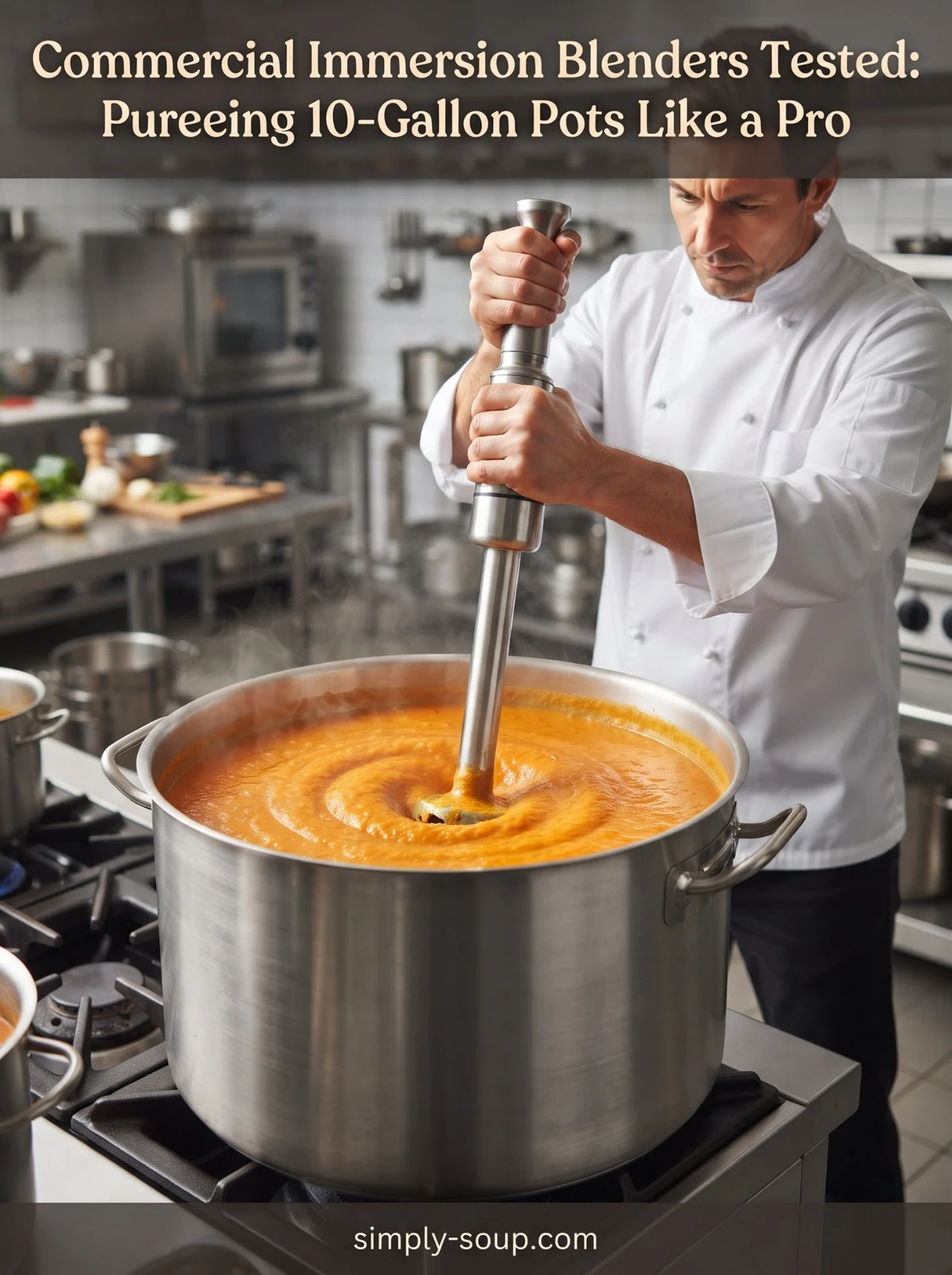
A little stick blender makes quick work of a saucepan of tomato soup. A commercial stockpot is a different job: more liquid, greater depth and a much heavier workload. Choosing the right machine starts with the batch and the pot, rather than the biggest wattage on the box.
To keep things simple, we have shortlisted just three models: a lower-cost Buffalo, a mid-price Waring and a higher-price Robot-Coupe. Each has a published capacity above the volumes discussed here. That makes them candidates for further checking, not a guarantee that every thick soup will blend equally well.
First, how much soup is “10 gallons”?
Ten US gallons is approximately 37.9 litres; ten UK imperial gallons is approximately 45.5 litres. That difference matters when comparing equipment. Also distinguish the pot’s brimful capacity from the amount of soup you actually prepare. Leave adequate working space for circulation and splashing, following the equipment instructions.
Measure the pot’s internal depth and your normal liquid level before ordering. A suitable litre rating does not automatically mean the shaft reaches the right working position. The motor must stay clear of liquid, and the cutting head must remain correctly submerged. Our stockpot buying guide covers the vessel side of the decision.
Three options at a glance
| Price level and model | Capacity / shaft | UK price reference* |
|---|---|---|
| Lower: Buffalo FS441 | 100 litres / 400mm | About £276 incl. VAT |
| Mid: Waring WSB60CK | 95 litres / 400mm | About £456 incl. VAT |
| Higher: Robot-Coupe CMP 400 V.V. | 73 litres / 400mm | About £576 incl. VAT |
*Nisbets advertised prices checked on 1 November 2026: £229.99, £379.99 and £479.99 excluding VAT respectively; figures above are rounded after adding 20% VAT. These are comparison prices, not Amazon quotes. Delivery, price and stock can change. Capacity figures are supplier/manufacturer ratings, not directly comparable performance scores.
The orange buttons below open Amazon UK searches for the exact models. We have not verified matching Amazon listings or availability. Check the full model number, UK electrical specification and included shaft before buying. These links contain no affiliate tags.
Lower-cost choice
1. Buffalo FS441 — a practical starting shortlist
The FS441 pairs a 500W motor with a detachable 400mm shaft and variable speed from 8,000 to 18,000rpm. Its published 100-litre capacity gives it nominal headroom above a 38–46-litre batch. The Buffalo manual confirms the capacity and shaft specification.
Why consider it: it is the lowest-priced commercial option in this comparison, with a removable shaft for cleaning and a straightforward specification. It is a sensible machine to ask a supplier about when you are equipping a small soup operation on a limited budget.
What to check: ask whether your thickest recipe and daily workload suit this model. A high litre rating does not prove faster blending or longer service life. Confirm replacement-part availability and the practical warranty arrangements.
Price and specification source: Nisbets FS441. The listing showed out of stock when checked.
Check it out on AmazonAmazon UK model search · Buffalo FS441
Mid-price choice
2. Waring WSB60CK — adjustable speed and a removable shaft
The UK WSB60CK is listed with a 650W motor, a 400mm shaft, a 95-litre capacity and a 5,000–18,000rpm speed range. Its removable shaft makes this an option to investigate if separating the blending assembly from the motor would suit your cleaning routine.
Why consider it: on the published figures it covers the batch volume comfortably, and its lower starting speed offers another point of comparison with the Buffalo. That does not establish which gives better control in your particular soup.
What to check: insist on the exact UK model. Similar-looking Waring machines sold internationally can have different electrical specifications. Do not treat a US WSB60 listing as interchangeable with a UK WSB60CK. Ask about current supply, servicing and compatible replacement shafts before committing.
Price and specification source: Nisbets WSB60CK. The listing showed backorder with availability to be confirmed when checked.
Check it out on AmazonAmazon UK model search · Waring WSB60CK
Higher-price choice
3. Robot-Coupe CMP 400 V.V. — worth a demonstration
Robot-Coupe specifies a 73-litre maximum batch capacity, a 400mm shaft, a 420W motor and self-regulating variable speed from 2,300 to 9,600rpm. The bell and blade are removable for cleaning; the manufacturer lists the shaft itself as non-removable.
Why consider it: the cleaning arrangement and speed control are concrete features to explore if soup production is a regular part of your working day. Robot-Coupe offers a demonstration request on its product page. Trying your recipe is more useful than assuming the higher price guarantees a smoother finish.
What to check: confirm the exact version supplied, practise the cleaning procedure and try the working position with your pot. Its lower wattage and lower stated capacity do not, by themselves, establish worse performance than the other two.
Sources: Robot-Coupe specifications and demonstration; Nisbets price reference, showing stock when checked.
Check it out on AmazonAmazon UK model search · Robot-Coupe CMP 400 V.V.
What a useful demonstration should show
Take the recipe you actually sell, not just a container of water. A smooth carrot soup and a thick lentil mixture place different demands on the equipment. Ask the supplier to demonstrate the appropriate batch size, starting speed and working position with a comparable pot.
Look for an even texture across the batch, comfortable handling and manageable cleaning. Ask how long the complete job takes, including setup and washing. Check the permitted running time and any rest periods in the exact model’s manual. A continuous-on switch is not permission to ignore operating limits.
Do not buy solely on wattage, rpm or maximum litres. Those figures describe aspects of a machine; they are not a measured ranking of soup quality. A demonstration can also reveal whether the handle height is awkward in your kitchen.
Blending a large pot with care
The pin is an illustration, not a guide to safe positioning or fill level. Use the instructions for your model and trained operators. Keep the vessel stable and leave working space above the soup; switch off the hob before blending and avoid leaning over steam.
Start at a low speed with the guard adequately submerged, keeping the motor and vents dry. Maintain the specified immersion depth and bottom clearance. Stop the blade before lifting it out. Disconnect the power before clearing a blockage, dismantling or cleaning; never reach into the blade guard with your fingers. The Buffalo operating manual illustrates these core precautions, but each machine’s instructions take priority.
Plan what happens after blending, too. A large batch needs an appropriate cooling and storage process. Our freezer guide introduces portioning and storage for home batches; a catering operation needs a food-safety process suitable for its production volume.
Which would we shortlist first?
Start with the Buffalo if purchase cost is the main constraint. Compare the Waring if its removable assembly and control range suit your workflow. Ask for a Robot-Coupe demonstration if you are willing to spend more and want to assess its handling and cleaning arrangement before deciding.
For all three, suitable supply, service support and compatibility with your pot matter more than a winner’s badge. If you usually make a few litres at home, this class of machine is probably more equipment than you need.
Quick questions
Can a domestic stick blender handle the same pot?
Do not assume so. Use only a machine whose instructions cover the batch, immersion depth and workload. Dividing the soup into appropriately sized batches may be more practical than buying commercial equipment for occasional use.
Does a larger capacity rating mean better purée?
No. It is a starting point for suitability, not a texture score. Recipe thickness, ingredient preparation, blade design and technique also affect the result.
Have these three machines been tested by Simply Soup?
No. This article compares documented specifications and supplier prices. It includes no invented test times, ratings or first-hand performance claims.
Are the Amazon links affiliate links?
No. They are ordinary Amazon UK searches. If a search does not show the exact model, check a specialist catering supplier rather than buying a similarly named machine without verifying it.